Sunday, February 23, 2014

29. A Second Visit to Milan 1970

2008 Piazza del Duomo Milano Italia
The Duomo of Milan
 I left Interlaken early and this time had no problem making it to Milan by evening.  There was room in the hostel and it was time to relax for a little while. All I did was walk around, usually down by the Doumo and sit in front of one of the neighboring cafes drinking a coffee or eating a gelato while watching the world stroll by, or take some time to walk to the railroad station, where there were always some street performers to watch.


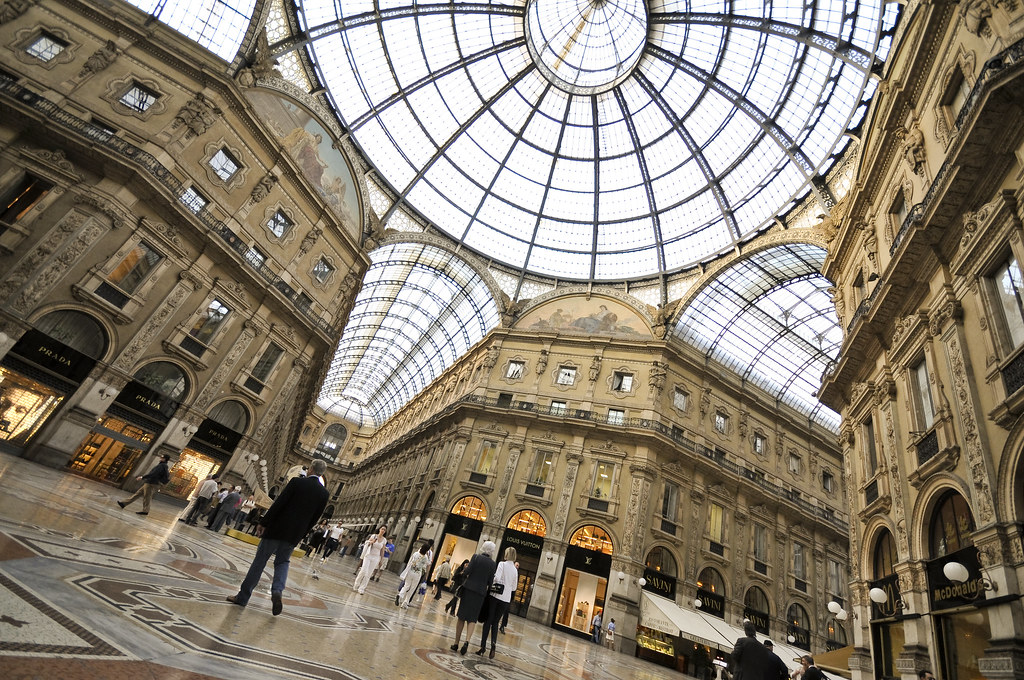
Inside The Galleria Vittorio Manuele ii
The Duomo of Milan is located in Cathedral Square (Piazza del Duomo) the main piazza of Milan.  It is one of the worlds largest "Gothic" cathedrals.  In fact it is the world's third largest christian church.  On one side of the square you have the famous Galleria Vittorio Emanuele ii.  It is an impressive five story arcade covered with a glass and iron roof in the shape of a cross now full of high end shops and cafes.  The structure is decorated with patriotic mosaics and statues.  It is one of the worlds first shopping malls.


The other end of this Gallery opens into another square that contains the famous La Scalla Opera House.

La Scalla Opera House

Also located in the Piazza del Duomo across from the gallery is the Royal Palace of Milan.

Royal Palace of Milan

As I was writing earlier, that is what was there in that one location to visit as a tourist.  What I enjoyed was watching the street life.  I sat off to the side of the square in front of one of the cafes with a good view of the street.  What I saw was amazing.  During the daytime, (late morning and early afternoon) you would see all the tourist hurrying here and there in their groups following a tour guide so they wouldn't miss anything!  During the siesta time (I do not know the Italian word for it) you would see many women standing along the sides of the streets usually near the intersections hopping into cars that would stop by and pick them up.  A few minutes later the same woman would be left of at the same intersection and then the woman would get into another car.  This was repeated at various intersections up to a certain time and then they all disappeared.  The area reverted back to a more traditional neighborhood.  This is the time that the young families came walking about, or taking an evening stroll with their children and grandparents before the evening dinner.  After that the night slipped into a world for the young dancing from one club to another.

McDonald's

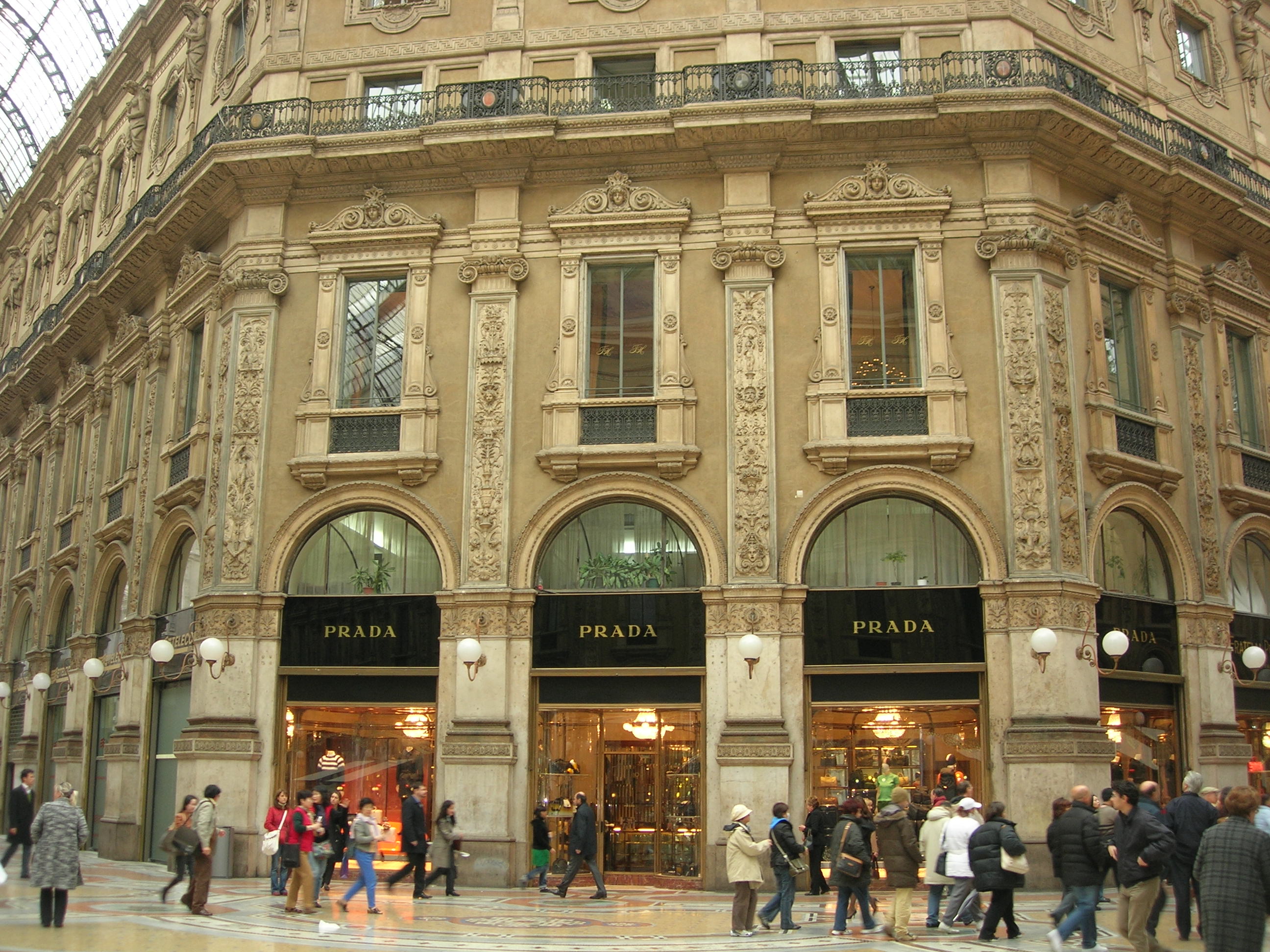
Prada
Another thing of note.  When I was there in 1970 there was no McDonald's in Milan.  While I was looking for photos for this post I noticed that there was a McDonald's in the Gallery from 1982 until 2012.  McDonald's was kicked out of the Galleria Vittorio Emanuele ii presumably because it was not upscale enough.


It has since been replaced by an expansion of the Prada Store in 2012.  Prada is, for those not in the know, an Italian Luxury fashion house specializing in ready-to-wear leather and fashion accessories, shoes, luggage, perfumes, watches, etc.,  I believe McDonald's is suing.


Monday, February 17, 2014

28. Austria Part 2 and Another Quick Taste of Switzerland, 1970


Actual Tram in Vienna 1970

The next thing I seem to remember is the transit system in Vienna?  You could ride the tram anywhere in the city.  Many of us thought it was for free but later on discovered it was not.  How it worked was on the honor system.  There was a set fare for everyone.  There was also a less expensive fare for children, students and seniors.  There was a drop box near the front and rear exits to the tram.  There was no one there to collect or make change or pass out the transfer tickets.  It was all by exact change and everyone had change if you needed it.  The only control I saw was, if you put nothing in the drop box, people stared at you, pointed and mumbled until you either figured it out and put change in the drop box or got off the tram.  If you stayed and put money in the drop box they would all cheer and then be able to speak your language and try to help and tell you which transfer ticket you needed and how to get where you were headed and what trams you needed to ride.

After a day or so, I headed south west to the lake district that is south of Salzberg.  I was looking for the American student that gave me his address.  I was riding with a man named Carl Erik Rosen.  He worked for The IRO Distribution Corp that I think was headquartered in Sweden.  He did his best to help me locate the students address.  We did find the address but the landlady told us that the American student was attending some lectures in Vienna.  I decided to continue on my journey and headed for Switzerland and Italy again.  As I was moving on, Carl Rosen handed me a twenty dollar bill and told me that when I was in a similar situation to pass it on and help someone else.  That I have done Carl Erik Rosen, That I have done.

Interlaken Corn Field
I eventually ended up with a ride into Switzerland and found myself heading for Interlaken again.  I was riding with a bunch of road weary travelers and while we were still outside of Interlaken, we were passing fields of corn.  Naturally there was no one around, so we helped ourselves to a couple of ears apiece to boil for our supper that night.  The corn was a little to early and I think it was actually silage corn, but it was still sweet and tasty.


Interlaken
I spent two nights at the youth hostel in Interlaken again.  While there, I remember walking through a few neighborhoods looking at and smelling all the fresh flowers that were growing in everyone's yard, fences and windows.  There was also a walk to the center of town to try some chocolate and fresh baked pastries and cakes!

SAMSUNG DIGITAL CAMERA
Chocolate Shop in Interlaken
At the youth hostel I met the girl I had traveled with from Milan to Rome.  She was now heading north while I was heading south again.   She had left Rome and headed for Naples and spent some time there and then worked her way back north through Italy.  She told me she wished that she had accompanied me through Greece and Turkey rather than going to Milan and staying in Italy.  Anyway, the next morning found her heading north while I headed south.  She told me the Professor who gave us a riding tour of the Milan to Rome route was correct, and to be sure to see Michelangelo's David in Florance!  But first, you have to go through Milan, Italy!


Wednesday, February 12, 2014

27. Austria, Part 1. 1970


After spending the night at the youth hostel in Salzberg,,,,,,,  I have no recollection of specifics in Austria.  I can remember different items but not where it was or with whom.  I do remember one persons name, but am not ready to tell you who it was until later.  What I do remember is that I broke off from the group in the Volkswagen van.  They were still headed north and I was not ready to go in that direction.

My first night in Austria, it started raining.  I remember going to a restaurant that some in the hostel knew about.  They served real schnitzel, sausages, and saurbraten.  I think it was the Austrian equivalent of a good English pub.  I met a few people, some students and some travelers.  One was an American student that lived near a lake southeast of there.  He gave me his address in case I was "ever in the neighborhood".  I also met a girl that traveled with me for a couple of days after.  We hitched to, I think, Vienna but am not sure.  What I am sure of was the fact that one of our rides was with a young couple on their honeymoon.  We rode with them for a few hours in what seemed like a rural area.  When they stopped we were at an exclusive resort.  We were met by a doorman, a parking attendant and a group of porters to attend to their luggage.  They invited us to stay and share a meal with them, but we could tell that they were being nice and wanted nothing but to be alone!

Beautiful Nature
We were back on the road getting small scattered rides that got us closer to our goal but not by much.  That evening we were still in farm country.  We were under an overpass, it was pouring rain and there was no traffic.  We saw a farmhouse almost a half mile away across a field with a barn that was a short walk from the road we were on.  We had intentions of asking the owners if we could spend the night in the barn but by the time we reached the barn the rain had changed to a heavy downpour and it was thundering and lightening.  We could tell the owners would not be back in the barn this evening.  The animals had already been fed.  There were two cows, a few chickens and an old workhorse.   When we looked around, we felt we were in a barn from the movie "Heidi".  On the walls were hanging a couple of old scythes and other old implements scattered about.  Also hanging on rails and posts were old harnesses, yokes and other tack supplies.  In a couple of stalls were an old plow with the yoke hooked up and ready to harness and two old horse drawn sleighs that had seen better days.  It felt like we were in a museum, but this was real.


We had ourselves a little supper with what we had, probably some bread and cheese and maybe some jelly and a piece of fruit before it got completely dark.  There was a kerosene lantern there but we were leery of trying to light it in a barn with fresh hay all over the place.  After we ate we moved our bags up into the hayloft and settled in for the night.  After laying our wet clothes out to dry we buried ourselves in the hay and watched the storm continue outside while we dried off and slept the night.

We had overslept the next morning.  When we woke up, the sun was shining and we could hear the animals lowing below as they were being fed by their owners.  We laid there quietly while we listened to a man and woman talking and laughing while the animals were being fed.  The people seemed like they were in a good mood and we did not want that mood to change by knowing we were there, so we remained hidden.

After they had left, we got out of our sleeping bags and quickly dressed.  When we got to the loft ladder and started back down we discovered a small table or stool next to the ladder with a tray of food.  Some boiled eggs, cheese bread and even two cups of milk left for us.  We had been caught!

Saturday, February 1, 2014

26. Greece through Yugoslavia into Austria! 1970


We decided to push on to Thessaloniki, arriving at dusk.  I had told the people that were traveling with me about selling blood there a few weeks ago and two of the people decided to do that before they traveled on to Southern Greece.  The rest of us were heading north to Austria through Yugoslavia.  We spent the night at the youth hostel and were joined by two more people the next morning on our journey.  We headed north towards the Yugoslavia border.  We picked this way because the owner wanted to head directly to The Netherlands and also for my comfort.  If we went the straightest way we would have driven through Bulgaria, Yugoslavia and Hungary.  I had just completed a military tour of duty at an intelligence gathering site in Turkey that March.  Because of the security clearance I held, I was supposed to avoid all communist bloc countries for, I think, five years.  Although I was partly rebelling, I felt I could not completely ignore those rules, so we picked a route avoiding all those countries except Yugoslavia, which we felt we could argue was independent from the Soviet Union because Tito was their President and he maintained  his country was independent from the soviet bloc!  This way it was also only one border crossing from Greece into and one border crossing out of Yugoslavia into Austria.  Today in 2013, our route would take us from Greece into Macedonia, then through Serbia.  Then after crossing into Croatia we would have skirted the borders of Bosnia and Herzegovina alongside Croatia and finally into Slovenia before crossing into Austria. This took us two days.
I drew the short straw and had to sit in the front seat being pounded by the hot air from the broken heater.  Because we picked up two new riders and were not sure if they carried drugs, we all went through customs separately again. We crossed the border at Evznoi Greece to Gevgelija, Yugoslavia, now Gevgelija, Macedonia. There was not too much I remember from this portion of my trip.  The roads were usually paved but not all.  It seemed that we spent the first half of the day climbing over or through mountains and with the little Volkswagen engine it was hot and slow going.  I do remember after going through one pass we stopped at a petrol station and one of our company traded a tie dyed shirt along with a Janis Joplin and a Jimi Hendrix tee shirt for a tank of gas.

Balkan Dreaming-for Çagla Hanim - Struga, StrugaWe knew we would be camping that night and after passing Belgrade we came across a farmers market in a small village and decided to shop for our supper.  We saw some vegetables we liked and went over to the farmer.  After traveling as long as we have, we always seemed to end up with a small handful of coins from all the countries we have visited.  Their language was completely "foreign" to us and no one spoke English.  I reached into my pocket and pulled out some small Turkish coins called kuruş and pointed to some potatoes.  The lady looked in my hand and picked out a coin, maybe a 25 kuruş coin, and started putting potatoes in my net bag.  There must have been close to three kilos.  I could not believe how many she gave me!  One of the girls with us was doing the same thing with tomatoes.  I remember nodding my head in thanks and starting to turn around and the woman grabbing my arm, reaching into her apron and giving me two other coins back!  I could have lived like a king there!!!

We got back on the road and about four or five miles from Zagreb on a side road, we stopped for the night and off to the side built a small cooking/bonfire.  We gorged ourselves on fresh tomatoes and fire baked potatoes.  The only downer to our trip through Yugoslavia was to come that night as we were trying to sleep.  It seemed to us that this part of the country was home to the worlds biggest and meanest mosquitoes.  We slept completely enclosed in our sleeping bags and yet they were still able to get to us by biting through the bags.  Needless to say, we got an early start the next day and circled around Zagreb into Austria.

What we had done was gradually climb up through the plateaus in Yugoslavia  and as we were crossing into Austria the mountain scenery was beautiful.  We actually got to see a lot of scenery that day because we spent a great deal of time walking.  The  Volkswagen van that we were riding in was completing its fourth  round trip circuit on the hippie trail and the engine was wearing out.  As we were crossing some of the alps, we actually got out twice going up the passes and walked next to the van with our backpacks chanting "I think I can, I think I can, I think I can" encouraging the little engine that could as the Volkswagen engine labored along.  As time passed we actually beat the van to the top of the pass once we were sure we would not have to push it.  The van made it up to the top of the pass to cheers of other people waiting to see if we would actually make it.  After that, it seemed almost all downhill to Salzberg Austria and the next youth hostel.

Friday, January 24, 2014

25. On to Greece - 1970

Hippie Van
We left Istanbul in an old beat up Volkswagen van with the owner driving.  After adding our luggage to the  back there were only six seats left.  The drivers seat, the front seat next to the driver and three in the back.  The owner did all the driving. The rest of us drew straws to see who had to sit in the front passengers seat next to the driver.  It was a drawing we did not want to win.  The heater was broken!  This would seem okay it being the middle of the summer and it being about 90*F or 32*C except for two reasons.  The first reason was that there was no air conditioning in the van.  The engine was air cooled and in this Volkswagen when the heater was broken, the heat could not be shut down.  The owner had the heater vent blocked of on his side but because the car engine was air cooled he needed the air to circulate so he did not dare cover the passenger side.  The loser had to ride in the front seat next to the heater vent!  I was lucky, I did not have to sit in the front seat until the next day! 

Our first stop was just shy of the border between Greece and Turkey.  This was intentional.  We all got out and grabbed our own backpacks and whatever we were carrying to cross the border individually.  It would probably have been different if we had known each other for a while but we had known each other for just a couple of days.  The problem was smuggling drugs across the border.  As long as we were separate it was fine and we were only responsible for ourself.  If we were together and one person was busted, we would all be charged as a group and no one wanted that.  We were at the Ipsala Turkey crossing.  It was a slow day and things went rather well.  We were done with the Turkish customs rather quickly and then went through the Greek customs which took a little longer.  The Greek customs agents took a closer look at the van and and removed a few panels in the doors and under the seats but after about thirty minutes the van was released and the owner quickly put the parts back on.  He said practice makes perfect, this had already happened to him at a few other crossings.  We had crossed the border, repacked the van,  and were on our way before noon.  Just a side note,  1n 1970 you could walk across the border at this crossing but because of illegal crossings you can no longer do it on foot.

One of the Beaches near Makri
We were back on the road and it wasn't quite noon.   We did stop and picked up some fresh fruit for our lunch while riding along the coast  between Alexandropoli and Makri.  It was a beautiful drive looking at the aquamarine sea and as we approached Makri, we could no longer resist the temptation.  We decided to stop and eat our lunch and go swimming in the Aegean sea.  We stopped along the beach and found a quiet spot well away from everyone.  The only problem we thought we had was that no one had a bathing suit and only one person had a set of shorts.  No problem, We were in Greece and they were liberal so we decided to swim nude but at the same time we made sure that we were well away from everyone else on the beach.  As it turned out, there still was a problem.  We were liberal but the mayor's sister was not, and that day she was also on the beach.  Waaay on the other end of the beach.  She must have had a walkie talkie or radio because the next thing you know there were three policeman arriving in two police cars.  They showed up with flashing lights and walked out on the beach where we were and talked to us while motioning to our clothes. We could not understand what they were saying but we put our clothes back on.  Then we were escorted back to the van  and they made it clear that we were to follow them into town.  With one police car in front of us and one behind us, they escorted us through a maze of streets to the local police station.  Once there, we were escorted into the police station and they collected our passports.  As far as we could tell, they could not speak English, German or French.  We could not speak Greek.  They did check our bags and the van for, we think, drugs and weapons.  They confiscated our weapons; a few hand knives.  The next thing that happened seemed very strange to us.

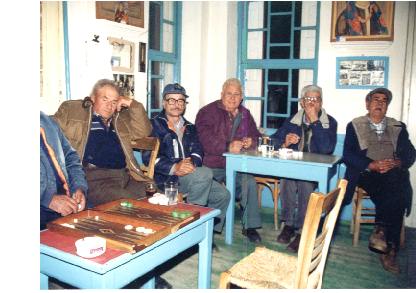
Coffee shop with Tawula Board
They escorted us next door to a small cafe or coffeehouse.  Even the girls that were traveling with us went inside the cafe.  The police kept motioning to us until we understood that we were not to leave from there.  We were fed some bread and fruit and given our choice of soda, tea or coffee and sat with the locals outside the cafe making friends with the old men that were there playing Tawula (a Turkish/Greek form of backgammon).  One policeman was always with us.  After we sat and paced and worried for almost an hour and a half a different policeman showed up.  We were escorted back into the police station.  The new officer smiled at us and spoke to us in English.  He apologized for the time we spent waiting for him.  He was doing some police work in another location and could not leave there until he was finished.  He told us that he was the only policeman in the town that spoke English.  They (the police), wanted us to know  the only problem was the mayor's sister.  We were on the beach the same time she was.  She was an old fuddy duddy.  She complained to the police and the politics in that town were such that the police had to show that action was taken and that they had done what they were supposed do.  They did realize that we had moved away from everyone and were far enough away that they were sure that she could not really tell if we were clothed or not.  They continued to tell us that if she was not on the beach that day, there would have been no problem at all.  They hoped that we enjoyed or snacks next door and said it was their treat for us being understanding.  They handed us back our passports and returned our knives telling us that they knew it was getting late but it would be easier if we went on our way before too many questions were asked.   We were more than willing to cooperate.  They then had to show us how to get out of town; once again we were on our way!

Sunday, January 19, 2014

24. Still in Istanbul - 1970


Yücel Hostel about 1970

Ottoman Luxury Hotel Courtyard
Staying at the Yücel Hostel was a treat.  It was a stop in Istanbul along the Hippie Trail.  It was across the street from the Aya Sophia Mosque and around the corner of Yenner's and the Pudding Shop.  Yenners was a small restaurant that had gone to seed and was only patronized by hippies n the road or staying in the area.  It was an information exchange place where you could find where to go in any country and leave messages for your friends and read messages from your traveling friends all on notes attached to a hanging rope by clothespins.  Remember, internet did not exist in those days.  The Pudding shop was much the same, except it was cleaner and had a larger customer base covering all the traveling social castes.  Here, along with many types of scam artists and more people selling  hashish were undercover cops looking to find buyers they would either jail or blackmail.  The saving grace was that you could always get an inexpensive good and tasty meal.  Also, there was the rich almost black chocolate pudding that was talked about all along the Hippie Trail.  The backpackers who did not have any money spent their nights in a tent on top of the roof of the Gulhane Hostel.  Those with a little money stayed at the Yücel Hostel.  Very little money was needed.  In the year 2005, The Yücel Hostel was redone and became an expensive luxury boutique hotel named The Ottoman Luxury Hotel.  Above is a photo of the courtyard redesigned for the new hotel.  During  the 60's the courtyard also existed but was mostly all concrete walls with brick decks.  When you walked out of the back lobby, you were on the top deck.  This deck usually had a few people sitting around at tables reading and making plans.  The lower deck was much busier.  Across the common area was a small building with a few tables and chairs crowded inside on the right as you went in.  On the left they had a small glass food counter that held various candies for sell along with fresh fruit, cheese, and bread.  The young attendant was stationed at a small table on the immediate left as you went through the door.  On both sides of the door were large windows.  The window by the attendant was always left open to let out the smoke that he produced while using a hotplate to fry the worlds best tasting omelets.  Because of the smoke produced in the small room, most of us ordered through the window and ate at tables in the courtyard.  On the left of this building was a small L shaped room that was opened as a small lounge where all the guests went to socialize during the cold rainy season.  This was mostly in the evening when one got tired of the scene at Yenners or the Pudding Shop.

File:Yenicamii 01447 Nevit.jpg
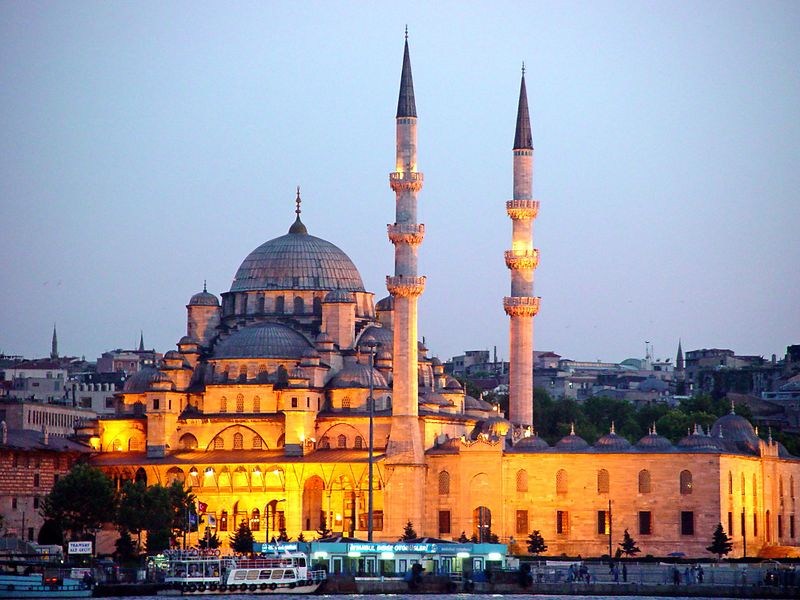
Yeni Cami (The New Mosque)
The hostel was located ideally.  It was in the old district of Istanbul (the Sultan Ahmet district).  When you walked out the front door and crossed the street you were at the beautiful Aya Sophia mosque.  Now a museum with both a strong early christian and islamic heritage.  Turn left and walk five minutes through the Gulhane Park you came to the Topkapi Palace.  If you turned right and walked up the street for five minutes past Yenner's and the Pudding Shop you arrived at the covered Grand Bazaar, a place where you could spend weeks without seeing it all and it would be worth every minute spent there.  When you came back out and continued up the street for a few minutes you came to the famous Blue Mosque.  Turn right coming out of the Yücel and then take your next right and walk down the hill you will come my favorite, The Yeni Cami (The New Mosque) and the famous covered Spice Market on the mosque grounds.

The Yücel Hostel was open 24 hours a day and was where I stayed whenever visiting Istanbul.  One would find a veritable treasure of different types of characters. The hostel was host to a wide diversity of guests from all over the world.  You could possibly meet a young group of Germans there for a couple of weeks.  You could meet an elderly group or couple there to see the sights or a young french girl that just wanted to be alone and read.  Another time it was a group of elderly and young nuns there to see all the christian sights.  One time I met a young Israeli woman that was entertaining us with her knife skills.  We later found out that she learned those skills while training in the Israeli army and she was visiting Istanbul while on leave.  Another time we met a young (American/Australian) couple traveling from Australia on an extended honeymoon.  One time there was a young naive Brit who was suffering from a case of diarrhea and would take any advice that he could get.  People were telling him to eat plenty of soft juicy fresh fruit like peaches, figs, grapes, and star fruits.  This went on for about four days until he finally realized that they were stringing him along.  On my last visit to Yücel's I met a person who had left the investment world and was writing a novel while on his travels.  He was into his second month in Istanbul because he had "writers bloc".  I think it was a case of too many of the wrong chemicals.  He was attempting to be the first person to write a novel with no characters!

Büyükada Surreys
On this last trip through Istanbul I met an older American man at Yücel's that was giving his sixteen year old daughter the trip of a lifetime after graduating from high school.  They had started the Hippie Trail in India and were traveling east back to London.  Daddy was a true Dad and no men got close to her, and she was having so much fun I do not think she noticed that the young ones flirted with her only up to a line that the father allowed.  He was ever present.  The girls father, to  provide company for his daughter, treated a small group of us to a day on the island of Büyükada in the Princes Islands.  Of course, he came along too!  After a short ferry ride, we got off the ferry and he bought us lunch at the kiosks by the landing.  The first one  offered a regular or a heavy dark bock beer on tap.  The next attached kiosk had nothing but scrumptious fresh oysters on a stick that were deep fried right there.  Then we spent the day riding all over the island in a light blue surrey with fringe on the top.  The Groom spoke English  and gave us a fantastic tour of the whole island.

The next week, I met a another traveler that had a Volkswagen van and was heading east.  I and four others decided to join him and share in the gas money.  I was on the road again and headed towards home.


Tuesday, January 14, 2014

23. Back to Istanbul - 1970


After visiting my friends in Yalova, it was back on the road towards the end of my journey.  Actually it was back on the ferry to Istanbul.  I recently found a poem that I had composed sometime during that time frame.

The Ferry

There is a girl
Very pretty and quite sincere.

Every week
We ride together

Her and I
Side by Side

When she sees me
She waves and smiles
And I do the same

On the last ride
She cried
As she and I left the boat

Each into our own worlds
Both speaking a different language


Missing my friends in Yalova, I found myself once again back in Istanbul. I went up and got a bed at Yucel hostel in Istanbul across the street from the Aya Sophia Mosque.  This is a place I stayed at many times. I was in the military and stationed for a few years in Turkey prior to this trip. We would go into Istanbul, get our room at the hostel, then rush over to the Hilton hotel where all the rich tourists stayed.  We would go to the restaurant and order the cheapest meal we could find on the menu, and then sit and listen to the tables around us until we located one where the patrons spoke english.  Once we located one, we would introduce ourselves telling them it was a pleasure to finally hear someone speaking english after being in Turkey so long, and could we show them around  to some of our favorite shops in the Grand Bazaar, where we knew the owners were honest, had good prices, and would not take advantage of them.  Usually It ended up being a good day showing the people parts of Istanbul they would not normally see.  At the Bazaar when the people were bargaining with the owners, we would confess to the tourist that we normally did get a percentage of their sale but that we enjoyed being with them so much that we would give up our share of the sale and that would usually be enough to seal the sale.  The tourist did feel good because they got a good deal, and they did get a good deal, the owner felt good because he made a good sale, and we would still go back to visit the owner later to get our percentage of the sale and usually have enough spending money for the rest of our visit in Istanbul .


Linda Booth 1970
Gulhane
Another time, we (a group of American military friends and I) were in Istanbul looking to visit the NCO (Non Commissioned Officers) club for dinner.  They had just changed their by-laws to allow us lower ranked individuals and our families to use the club.  The problem was that they had a dress code.  One of our friends, Linda Bradbury (now Linda Booth) was a woman and was not wearing a dress or skirt.  What did we do?  We went back outside and around the corner.  One of us men took off a tee shirt.  He had on two layers.  We surrounded Linda as she put on the large tee shirt and took off her jeans, tied a ribbon or something around her waist and we walked back in the club and were seated because Linda was now wearing a "dress"! 


St.-Anthony-of-Padua-Church
Saint Anthony of Padua Church
The Saint Anthony of Padua Church is a Minor Basilica located on Istiklal Ave in the Beyoglu section of Istanbul..  This was built by the Italian community in 1725 and rebuilt and expanded around 1906-12.  Pope John XXIII was posted here from 1934-44, and said Mass in this Basilica as a priest and was appointed Apostolic Delegate to Turkey and Greece and titular archbishop of  Mesembria, Bulgaria.  He took up his post in 1935 and used his office to help the Jewish underground in saving thousands of refugees in Europe from 1934 through the Holocaust.  The Basilica allows visitors but is still quite active locally.  Saturday Mass is in Italian, Sunday has three Masses, one in Polish, one in English and one in Turkish, weekday Masses are in English and Tuesday Late Morning Mass is in Turkish.

Rejans
Another favorite place was Rejan's restaurant that was around the corner of the Basilica at the end of an alley named Olivya Geçidi.  It was opened in 1931 by the White Russians fleeing the Bolshevik Revolution.  They were famous for their traditional Russian fare such as roast duck, chicken kiev, beef strogonof, and a fantastic borscht.

Rejans
The restaurant walls were surrounded with dark oak wainscoting five foot high and walls that went up another  fifteen feet with a balcony at one end.  The service was fantastic.  They actually had little old ladies dressed in black with white ruffled collars who prided themselves on speaking and taking your order in the language they were addressed. 

Friday, January 10, 2014

22. A short trip to Karamürsel

It is now time to start heading backup to London, but first here are some quick photos from Karamürsel.

KOCAELİ KARAMÜRSEL GÖRÜNÜŞ KARTPOSTAL


Karamürsel


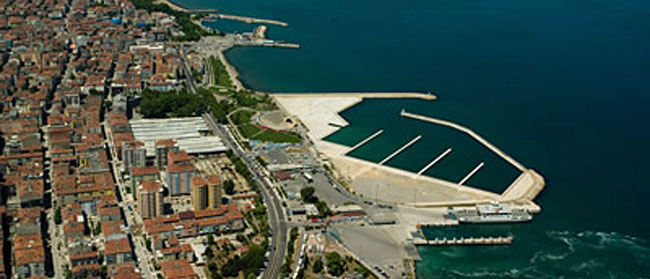
The town of Karamürsel  is just down the road east from Karamürsel Hava İstasyonu (Karamursel Air Station).  It is also on the coast of the Maramara Sea. 


I never spent much time in Karamürsel.  It was a much smaller version of Yalova, but the American families that lived there loved it.


Friday, January 3, 2014

21. Followup on Yalova


I have been blessed by God.  I mentioned in a previous post that I had lost all contact with my friends in Yalova.  That has been corrected with a stroke of luck. I laughed with glee at renewing contact with some precious old friends.  It has been forty three years since I have seen them and it is pleasing to me that they are still my friends and that they still consider me their friend.


Clockwise are Selma, Belma, Süheyla, and Layla with their Mom

It also tells me that Yalova was not destroyed as I thought.  Part of the original still exists in the people that lived and still live there. Here are five of the people that I remember.  Their mother, Fahriye, is the person I talked about in my last post.

The four sisters going clockwise surrounding Fahriye are Selma, Belma, Süheyla, and Layla.  

FÜZEN ART Gallery - Kuzguncuk, Istanbul, Turkey

FÜZEN ART Gallery


Selma and Süheyla
 
Layla passed on in 2004 and her husband Nurdogan in 1990.

They had two children.
The eldest, Volkan, has two children, one is a student at the university and the second is in high school.  They live in Istanbul where he has an art gallery named The Füzen Art Gallery.
 Layla's daughter Elvan has one son studying at the Unıversity of Nottingham in England. 


Süheyla still lives in Yalova.  Her Husband died in 1990.  She has two sons that are married

Selma has 2 sons and two grandchildren.  She and her husband live in the resort city of Marmaris in southern Turkey bordering on the Mediterranean sea.  They spend the winter living in Yalova.  One son lives in Germany with his family and the other in Istanbul.

Belma also lives in the city of Marmaris.


 I find it interesting how some things remain in our minds.  The friends we have not seen for 43 years have not aged. We still think of them as they were, not as Grandparents with a few well earned wrinkles.

 Selma and Granddaughter


Friday, December 20, 2013

20. Yalova - 1970

Fruit Market in Yalova

These are a few photos of Yalova taken around 1970 by a friend of mine named Richard Frazier.  He was the photographer among my group of American friends in Turkey.

 As in most places, The military personnel stationed there tended to fall into different social groups.

Yalova Ferry Dock with Truck loading on Ferry
.

In Turkey, there were four major groups of people stationed at the base.  The first type were the people that were stationed at the base and never left it.  For some reason they were afraid to mix with the people from the town and limited themselves to the small three square miles of the base, afraid to try anything new.  They basically did their jobs and nothing else but keeping track of how much time they had left in "this horrible country" and complained about any little thing they could think of.

 The second type, for lack of a better description would have to be called "safe ones".  They did get off the base and see parts of the country they were stationed in, but were always "safe", taking command sponsored trips on buses with English speaking tour guides to see the sites.

Same Ferry Dock With Incoming Passenger Ferry


The third group consisted of people that were much more open to learning some of the local culture.  They would go to town, shop at the local market, possibly catch the ferry to Istanbul, go horseback riding across from the base, or take a trip to the beaches, but always with fellow Americans so they would not have to mix with the locals.


I was a member of the fourth group.  They were the people that lived in or mixed with the local community and embraced most aspects of the culture.  We were welcomed by our neighbors and became part of the community.  We shared life with the neighbors.`

One woman I knew went to the local beauty parlor with her infant only to find out that he was speaking to the local women at the shop with Turkish baby talk before English.


Corner Store Across from Our Apartment

When it was noticed that all the young girls were playing together in one neighborhood, the American wives would be invited to a neighbors home for tea.  That included the girls who got to act like the grownups having a tea party with their mothers.  They were needed to translate between their parents.  Children learned languages faster and more readily playing together than their parents did.  To play together you had to communicate and the children could communicate!


I was friends with an American family who lived in a second story (third floor) apartment.  Their son was an energetic four year old who was liked by the neighborhood.  One day he fell off the balcony into the street.  He somehow was unharmed but his mother tripped running down the interior stairs to get him and was quite visibly bruised.  None of the local men would speak or acknowledge her husband until his wife and son were invited for tea.  The women and children questioned her and her son.  The son did a lot of translating for his mom.  After a while, the women got up and called their husbands and elder sons in and talked with them.  According to the wife, they all came in with grim faces and left with smiles of relief.  They asked their wives to find out if my friend actually did trip and for assurance that her husband was not beating her.  Imagine your life being in the hands of a four year old learning a new language.  The boy's father was very happy to be, once again a welcome part of the neighborhood.  

Owner's Son Tending the Store

I was friends with a Turkish family in Yalova.  They owned a house near the main boulevard next to the beach.  The family was a household of two grown single women living with their widowed mother named Fahriye Yakali.  They also had two sisters that were married and had children.  Dinner was always fun.  Usually about six or eight adults.  No mater what he meal, we always had fresh fruit, and a community salad of whatever vegetables were fresh, including fresh herbs and lemon.  Most meals were community style with special plates and bowls for the children.  We were always talking about many different topics, usually in English for my benefit with one exception, Fahriye annem (my dearest mother), Fahriye Yakali.  As I grew up in my home town I learned to talk with my hands.  She talked with her hands.  Most times we seemed to understand each other better without the help of the others.  She was a wonderful woman that I loved.  She introduced me to her friends, had a great sense of humor, and had a family that was fun to be around.  Her family invited me to dinner many times because, according to her family, if Fahriye knew I was coming for dinner, she would fix a special dish for me to try.  Did I say that even then, the way to my heart was through my stomach!


After dinner it was the local custom for the families to walk along the street and exchange greetings with each other.  The children would walk in the front or alongside the women and the men would follow to protect the family.  We Americans were taught that the Turks were a patriarchal society, not in that household!  Before we went out for our evening stroll, we men had to get the okay from Fahriye about what we would do that evening .i.e. stop for coffee or possibly a quick game of Parcheesi or dominoes at the mens coffeehouse.  She would never embarrass the men in public.  If she had said yes at home, and the men invited us, we could enter the coffeehouse anytime during the walk.  If she had said no earlier, we would find an excuse to say not tonight or maybe later, one of the kids were ill, or it was going to be an early morning.  I do not know where this little woman's power came from but she had it.  She was, to my knowledge, a community leader among the elder women in the neighborhood and by proxy, maybe the town.

I am retired and have no deadlines other than those self imposed and some of my grand children are visiting for a few days. As a result there will be no more posts until after Christmas, Yılbaşı and Kwanza.  Whichever you celebrate, have a joyous holiday and see you in January!


Monday, December 16, 2013

19. Istanbul to Yalova - 1970

At that time there was a Ferry that left twice a day from Istanbul to Yalova with two stops at the Princes Islands.  One was the island of Heybeliada and the other was the island Buyukada.  The first one was not developed in the 70's.  It was just a Navel Cadet school and a Greek Orthodox Seminary with a few homes The second one was Buyukada, a resort island with no automobiles, just donkeys and horse drawn carriages.  The only motorized vehicles allowed are service vehicles (ambulance, fire, police and I think a garbage truck). 

Buyukada

From there, it is on to Yalova and the end of the first half of my journey.  Yalova is one of the two towns near Karamursel Air Station, a base that I was stationed at from 1967 - 1970.  I spent most of my time either visiting or living in Yalova.  Yalova was virtually destroyed in August 1999 by an earthquake that killed about
Relief After the Quake
10,000 people in the Yalova area itself.   It has since rebuilt but I an afraid it will never be as we remembered it during the 70's, a vibrant seashore international community with a strong work ethic.

After the Quake in Yalova


 Now it seems that everything was built over as a resort and it seems only catering to tourists.  I know I am probably biased in my view, but I have never been able to reconnect with my Turkish friends.  Here are a couple of photos of how it is now.  Hopefully, my next post will be about how it was in 1970.


The New Yalova
The New Yalova
Thought 1

Lilliputian man,
Seas of time,
Swirling

The New Yalova


Thursday, December 12, 2013

18. Thessaloniki to Istanbul - 1970


After our walk back down the mountain path, we got in the car and drove directly to Thessaloniki.  I was let off in the center of the city near the youth hostel.  I had just enough for money for one more night in a hostel.

http://www.railfaneurope.net/pix/tr/car/night/Bcm/b699.jpgThe next morning it was off to the city hospital to get my blood typed.  Once you were typed, they would give you a color coded card identifying your blood type.  Then you would go outside with the card and set around the hospital steps with this card over your neck.  Families whose members were having surgery that day would walk through and pick you out and take you back into the hospital to have your blood drawn if a transfusion was needed for the surgery.  For this they would pay you something like the equivalent of fifteen dollars cash.  This was a lot for some of them, especially if they needed more than one.  Many people not used to this system would break down and end up donating their blood.  When you did this you had to accept the money and then give the family the money back yourself.  Other people would take the money, but out of guilt would come back a month later and donate.


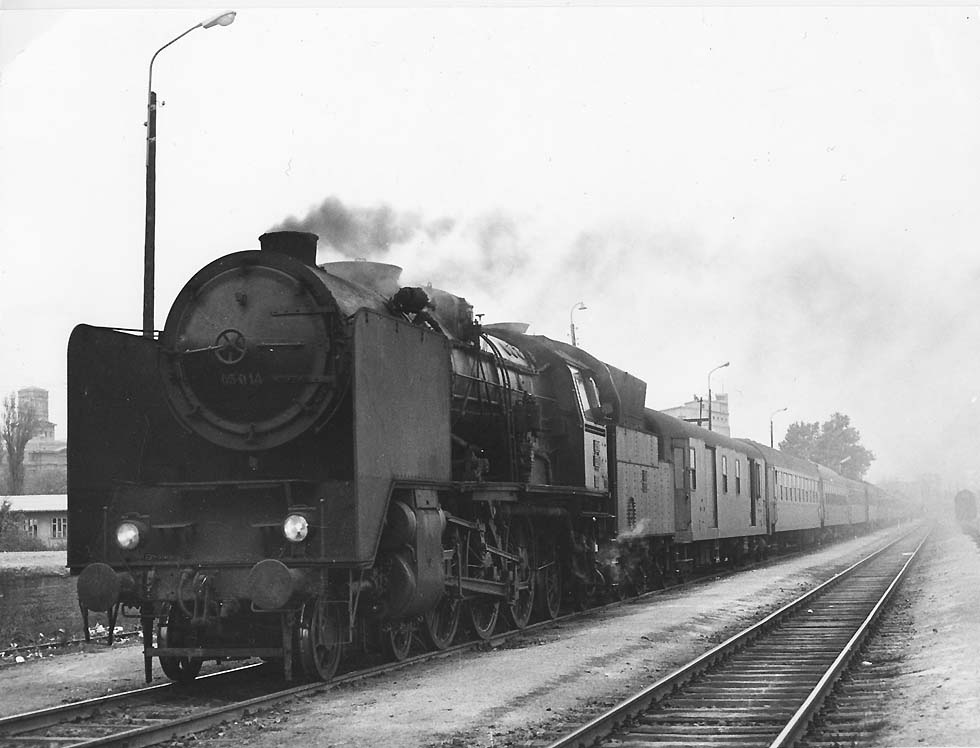
This gave me enough money for a train ticket to Istanbul and ferry ticket to my final destination, on the Sea of Marmara, Yalova Turkey.I bought a loaf of bread and got on the train.  The train was powered by an old steam engine straight out of the old west.  1860's style.  The passenger cars were European style.  a series of glassed in seats that would seat six going down one side and the aisle going down the other side as pictured, where many people spent there time walking, stretching, sightseeing, and getting fresh air.  Sometimes it was a battle between cigarette smoke and the black smoke and cinders from the trains smokestack.  The picture shown is actually the orient express in 1971 that ran between Paris and Istanbul  until 1977.  The train I was on was older and the accommodations, like berths and dining cars, were  nonexistent.  The train was sort of a local and took about 24 hours. We were on our own for meals and drinks.  We left late morning or midday, I am not really sure.  Some of our stops were three or four minutes.  During that time we would rush out and get a quick drink from a fountain and jump back on the train as it was leaving.  I met someone that was in the same financial straits as me.  I had the bread, and he had a can of sardines.  I do not like fish but that day, I was happy to share my bread for some of his fish!  So much for maintaining standards!


The scenery was spectacular and the border crossing was uneventful.  We arrived at the Istanbul train station about noon the next day.

Monday, December 9, 2013

17. On the Road to Thessaloniki part 2 1970


 Meteora-2 - Meteora, Trikala

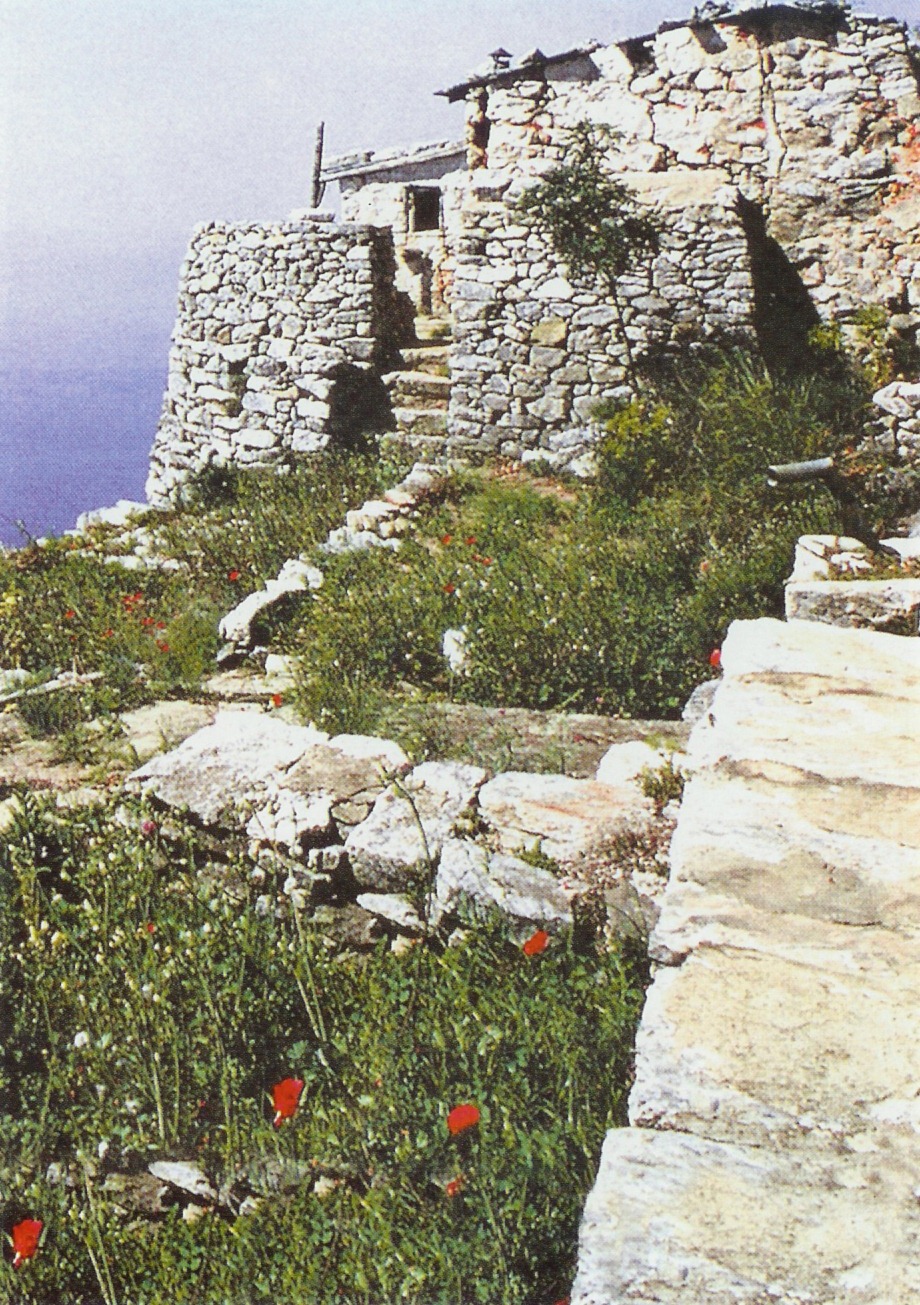
My ride that morning was much better than the day before.  I got a ride with a gentleman from Germany who had lived in Greece in the past and spoke the language.  He was on holiday hoping to visit some monasteries.  A few that we tried were not open for visitors or had a long waiting line.  The entry method was being hoisted up the side of a mountain in a basket.  He had given up on finding one and was thinking of heading on to Thessaloniki when we drove around a bend and we looked up and saw a small way station monastery on the face of the cliff.

As we got closer we could see a small footpath going up the side of the mountain.  We wanted to get closer but at the same time did not want to intrude.  We also did not know if anyone was there.  As we stood there outside the car, we could barely hear someone calling.  We thought it was a woman calling her goats but as we looked up, she was waving at us and urging us up the path.  We accepted her invitation and climbed up the path.  The man I was with appeared to be healthy and I was in pretty good shape at the time, but it still took us at least 20 minutes to hike up the path to the crest of their home/monastery/farm.

There were two people there.  It was an old lady about 60 or 70 and her mother.    Her mother stayed up there all the time because it took her too long to hike up the trail.  It took her (you guessed it) about 20 to 25 minutes to climb the path.  The younger one went down the path to catch transportation to town for supplies and then carried them back up the mountain.  She and her mother lived there and kept goats and chickens with a nice looking dog that herded the other animals for them.  They had a small vegetable garden off to the side where some flat space was available and a small barn like structure underneath part of their building for the animals.  She told us they lived there to take care of traveling and hermit monks that were passing through on pilgrimages to and from other monasteries and hermit caves.  I think by today's standards it would be called a Skete or way station.  They kept them fed, washed their clothes and basically took care of their worldly needs so the monks could spend their time praying and mediating.  They insisted they were not nuns but this had been their lay ministry for her entire life and most of her mother's.  I think they would today be considered female monks.

They invited us inside to see their home.  They lived in one room sharing a small bed, stove and a simple wooden table with two chairs.  They had a trap door down to the barn and, I think, a root cellar.  There was one window overlooking the valley that got both morning and afternoon sun and another window by the door that looked towards the path and their garden.  The walls were covered with religious paintings,  icons and one newspaper print of JFK that was printed.  Many of the paintings were painted on the walls and some were framed.  Which were icons and which were just painting I could not tell you.

The rest of the home was carved out of the sandstone rock and had two levels.  The top level actually consisted of an alter with painted icons, some painted directly on the sandstone walls, some painted on wood, and wooden hand carved icons surrounding the alter.  The cross was carved from stone into the window and glowed from the sunlight flowing through the window and surrounding the crucifix.  The lower level was the monk's cell with a small library in a wooden bookshelf and a small wooden cot.  A small workplace with woodcarving tools and paints also took up space in the cell.  There was another window through the stone wall but you could not look down from it, only up.  I was impressed much more with this place than the Vatican.  The faith of the two women, combined with the simple beauty and serenity left you with a feeling of peace and contentment.

After showing us their place, they insisted on feeding us, telling us this is what they did.  We sat down and they fed us a large bowl of a warm bean stew that I had learned to call pilaki in turkey, and a large hunk of bread slathered with goats butter.  It may have been the atmosphere but that was some of the best pilaki that I have ever had.  As a result of my travels and limited finances my stomach had shrunk and as I was getting near the bottom of my bowl, I asked the man I was traveling with (he translated for me) if it would be considered an insult if I did not finish my soup.  The local Greek custom was the same as the Turkish one and as he was telling me yes, the daughter was laughing and reaching over my shoulder and placing another ladle of pilaki in my bowl.  I think she understood English!  It was a long walk back down the mountain.